Friday, 22 May 2015

Youth unemployment and education participation in the UK and Europe

Dr Stefan Speckesser is an empirical economist specialising in evaluation methodology, programme and policy impacts and the returns to investments in vocational education. He has been Principal Economist of the Institute for Employment Studies since 2010.


In this blog post, we focus on the situation of 15-19 year olds using the most recent EU micro-data available to independent researchers (from 2012). More recent data for selective indicators and a comparison of youth unemployment rates and youth unemployment ratios for the whole group of young people (15-24 year olds) can be found here.


An obvious and well-established measure for understanding the effectiveness of institutions facilitating young people’s transitions into work are youth unemployment rates[1], which relate unemployed jobseekers of a particular age range to this age group’s total labour force, that is, people either working or looking for a job. The top panel of Figure 1 shows this indicator for 15-19 year olds using consistent data from the EU Labour Force Survey. The the data reveals, the labour market for young people in the UK compares relatively favourably with most other EU Member States, although the UK’s unemployment rate is higher than in Germany, Austria or the Netherlands.

However, the comparison of unemployment rates is greatly affected by institutional differences because countries with large-scale apprenticeship systems, such as Germany and Austria, include apprentices in the total labour force. In contrast, unemployment rates are higher in many other countries, where vocational education and training (VET) is primarily college-based and these individuals are not counted as part of the labour force.

Therefore, comparing unemployment ratios, which relate total youth unemployment to the whole population of the 15-19 year olds - including those that are currently in school - , results in fewer measurement problems. Figure 1 (bottom panel) shows that the youth unemployment ratio in the UK is among the highest in Europe. In relation to the other big EU economies, Germany (unemployment ratio 2.6%), France (5.1%) and Italy (4.8%), the UK’s youth unemployment ratio is two to four times bigger. 

These findings are interesting as they suggest that countries with very different institutional designs can show similar youth unemployment ratios: Countries with employment-centred VET-systems like Germany and Austria achieve relatively low youth unemployment, but – at least for the youngest group in the labour market of the 15-19 year olds – so do countries with upper secondary vocational education in colleges like Poland and France.

Figure 1: Unemployment rates and ratios for 15-19 year olds in Europe
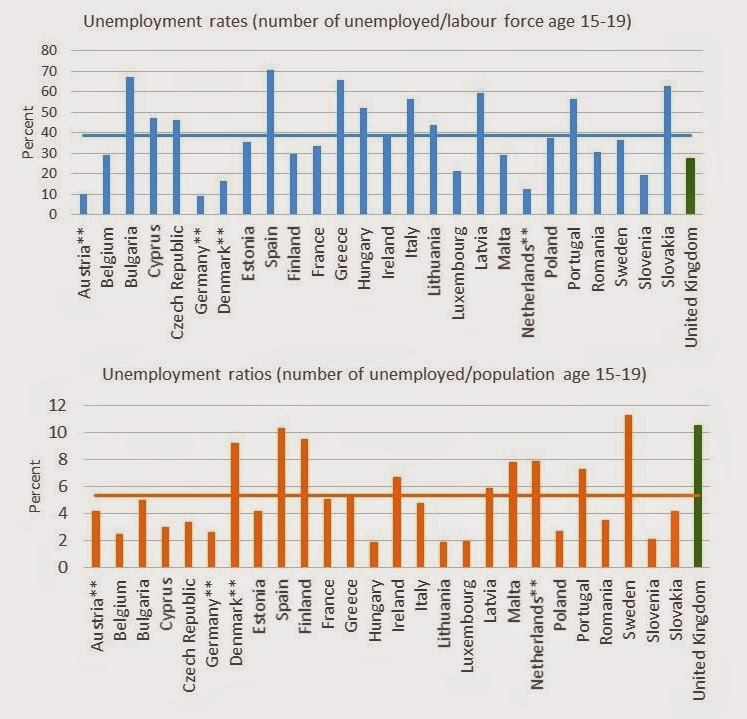
Notes: ** Countries with ‘Dual systems’ of vocational education and employment (incl. apprenticeships).

Source: European Labour Force Survey micro data, own calculations.

The common feature of these countries is that young people, including those not aiming for academic education, continue to participate in education for longer: In Germany, compulsory education participation ends when people turn eighteen (in most states), including apprentices’ participation in vocational education colleges. In Poland, where compulsory education also ends with eighteen years of age, young people outside general secondary schools participate in full-time (basic) vocational and technical schools for two years. In France, where mandatory schooling participation ends with sixteen years of age, post-16 participation is lower, but about 87 per cent of all 16-19 year olds participate in general and professional Lycées. Compared to this, young people aiming for a non-academic route in the UK make transitions out of the education system earlier in the life and are relatively more affected by youth unemployment. 

Education and Vocational Education & Training (VET) make the difference


Obviously, education expansion itself decreases youth unemployment because it postpones labour market entry, but there is more to it than a simple effect on unemployment statistics. A body of robust evidence on the substantial benefits of investment in post-compulsory education exists, with statistically significant estimates on the percentage point improvements of young people’s employment and earnings outcomes if they achieve general and vocational qualifications – compared to the counterfactual non-achievement. As suggested by Human Capital theory, knowledge and skills remain the crucial mechanism for improving the labour market position of young people.

Moreover, continued modernisation and technological change increase the demand for higher level skills and reduce opportunities for young people to move into traditional entry jobs. In such roles young people were able to gain practical experience, initially undertaking easier tasks in the workplace while firms trained their young employees up for their own benefit. The loss of this labour market segment has resulted in both a lack of opportunities for young people and an overall shortage of skills, which affects the UK’s growth prospects. As written in Sandra’s last blog post, policy in the UK aims to make a difference by increasing the age of compulsory education participation to 17 (from 2013) and further to 18 from autumn 2015.

Increasing education participation seems to be the crucial mechanism to improve the situation of young people. The comparison of EU Labour Force Survey data in Figure 2 (top panel) shows that the UK’s position in engaging 15-19 year olds in education is one of the lowest in EU, at 79%. Education participation is almost 10 percentage points higher in France (89.9%), more than 14 percentage points higher in Germany and more than 15 percentage points higher in Poland.

When considering that the UK’s tertiary education achievement rate is 40%+ of 30-34 year olds (ten percentage points higher than in Germany, see Target Tertiary Education of Europe 2020), the statistics are evidence that the UK education system delivers very successfully education at highest levels, but offers fewer opportunities for school leavers to acquire skills and recognition for professional roles at intermediate levels than other countries.

In recent years, an important element of improving such opportunities was the reform and extension of apprenticeships and traineeships, combining employment with formal education.[2] The comparison of the UK and other EU Member States supports this strategy. Figure 2 (bottom panel) show transition to VET rates - the share of pupils who leave full-time education and move on to combining work and education. As can be seen in the chart, there are large differences across countries in terms of how much employers are involved in vocational education. Countries with “Dual systems” combining apprenticeships in firms with state-run schools providing vocational education (Germany, Austria, Netherlands, Denmark)  have a very high VET transition rates. Those with mainly classroom based systems, like France, have very little employer involvement in vocational education and consequently have a low transition to VET rate. Recall from Figure 1 (top panel) that countries with dual systems are also the countries with relatively lower youth unemployment rates. 

Figure 2: Education and training participation indicators for 15-19 year olds in Europe
Notes: Transition to VET: Those combining education and work as a % of all in full-time education who left since the previous year (based on the retrospective question of the European Labour Force Survey on individual’s status a year ago.)

** Countries with ‘Dual systems’ of vocational education and employment (incl. apprenticeships).
Source: European Labour Force Survey micro data, own calculations.

Improvements the UK, but more has to be done


While the labour market situation for young people has been improving significantly over the last years in the UK, the European comparison shows that higher youth unemployment is associated with lower post-compulsory participation in education, in particular vocational education. However, it is crucial that the courses and routes offered to young learners are of high quality if the expansion of post-16 education is to reduce youth unemployment and increase skills among the population.
We can learn a lot from other countries about how to improve education for young people and prepare them for occupational roles. There are many elements from ‘Dual systems’ in Germany and Austria combining work in firms, high quality vocational education and clear educational standards, which can help to further develop UK vocational education. 

Similar to England’s vocational education system, the Dutch system offers both mainly school-based programmes and apprenticeships, with both resulting in the same qualifications, while producing much lower youth unemployment. Poland achieves high intermediate skills levels and relatively low youth unemployment with a primarily college-based system. 

In the medium term, the UK will not be able to move to a system where most of Vocational and Further Education consists in apprenticeships, even though the recent calls for more apprenticeships by all parties suggest a desire by policy makers for this to happen. We must ensure that the alternatives for those not able to get an apprenticeship are of a high standard and lead to similarly desirable qualifications. 

CVER’s aim is to produce robust evidence to further understand the impact of vocational education on students’ transition to jobs and earnings later in life. This research will help inform the policy debate on education and labour market integration of young people.

This analysis is part of a report on “Performance and Key Drivers of Youth Labour Markets in Europe” for research on “Strategic Transitions for Youth Labour in Europe (STYLE)”, funded by the European Union’s Seventh Framework Programme. The project aims to provide a comprehensive understanding of the causes of very high unemployment among young people and to assess the effectiveness of labour market policies designed to mitigate this phenomenon. The forthcoming research report will be published here.

[1] Unemployment is defined according to ILO convention and covers all young people, who are out of work, have been looking actively for work in the last four weeks and are available to start working in the two weeks or who found work and will start within the next two weeks. Unemployment rates express total number of unemployed as a percentage of the economically active population (i.e. people in employment or ILO-unemployed) of the age group in focus. Unemployment ratios relate total 15-19 ILO-unemployment to the whole population of the15-19 year olds.


[2] Since we do not have EU-wide data on apprenticeships, we focus in this description on 15-19 year olds leaving full-time education to start employment combined with education participation as a percentage of all young people leaving full-time education.

Friday, 15 May 2015

Apprenticeships at the top of the new government’s agenda

Dr Hilary Steedman has been engaged in research on apprenticeship, vocational training and labour market transitions since the early 1980s. Here she writes about the new government's priorities for the VE sector.


It was unprecedented and significant that David Cameron, in his first speech as Prime Minister of a Conservative majority government, included apprenticeships among the priorities of the new government. The 2010-15 Coalition Government had also prioritised apprenticeships but early on allowed a rash commitment to increase numbers to damage quality and reputation. 


A change of direction (and Minister) late in 2012 and the publication of the Richard Review of Apprenticeships  produced an important change of direction in government policy characterised by
  • emphasis on employer ownership of standards,
  • rigorous and reliable assessment and
  • aspiration for all apprenticeships to lead to (at least) Level 3 skills (equivalent to A-levels).

In their 2015 election manifesto, the Labour Party embraced Level 3 apprenticeship skills and made a welcome but vague commitment to guarantee a place for those suitably qualified.

In startling contrast, the Conservative manifesto, equally enthusiastic about apprenticeships, fell into the numbers trap they had previously struggled to escape from and promised three million apprenticeships without regard to quality.

Apprenticeships were dealt an even more deadly blow in the Conservative manifesto by the proposal to somehow make apprenticeship compulsory for young people without a job.  By all means provide work experience and training for young people as a way of accessing the labour market.  But apprenticeship should be a privilege not a punishment. Let us hope the new government does not choose to go down that particular road.

In fact, the new government would do very well to continue with the policy pioneered by the Coalition in its last three years of government:
  • Apprenticeship as a quality offer predominantly for young people aged 16-24,
  • The further development of the apprenticeship route leading from Further Education through to Higher Education and a degree and
  • Rigorously assessed employer-developed skill standards.

As ever, the challenge will be to make apprenticeship attractive enough for the offer from employers to match the demand from young people. Two policies can help here.  First, in the additional years of education now required of them, young people seeking an apprenticeship should be encouraged to acquire the general education, work experience and maturity that will make them attractive to potential apprentice employers. Second, the limited funds available for the skills budget must be used as efficiently as possible. The potential of economies of scale in the delivery of apprenticeships should be urgently explored. These include
  • Simulated interactive assessment programmes to reduce assessment costs – currently huge; see here for examples;
  • Group Training Associations providing for groups of small employers – see an influential report from 2012;
  • Integrating off-the-job apprentice learning into FE provision at marginal cost.

If savings could be made in these ways, public funding could be targeted more effectively on a quality apprenticeship offer in the sectors needed to promote growth and productivity.

Tuesday, 24 March 2015

Investing in skills: challenges for vocational education policy-makers and researchers

Prof Sandra McNally is the Director of the newly-established Centre for Vocational Education Research, and is based at the Centre for Economic Performance at the London School of Economics (LSE). Here she sets out the aims for the new Centre she leads.  


‘The UK needs to put an end to the waste of human resources that comes through poor education and the inability of a significant proportion of society to participate effectively in the economy.’ That was one of the headline messages of the LSE Growth Commission when it reported in 2013. The commissioners also pointed to ‘years of inadequate investment in skills’ as one of the longstanding structural weaknesses in the UK economy.

A central plank of the policy response must come through improvement of vocational education as this is where the majority of young people pursue courses in the post-16 phase of education. Although the Wolf report (2011) notes many successes of vocational education in England, it also highlights the inadequacies of a system that fails too many young people and therefore is not achieving its potential for individuals, firms or society more broadly.

The newly established Centre for Vocational Education Research (CVER) aims to help efforts to change this, enabling the sector to become a driving force for economic growth and social mobility, as it is in other countries.


The supply of skills

Ultimately, the biggest challenge facing the vocational education system is to improve both the quantity and quality of the skills it produces in learners who then supply the labour market. At present, there is still a ‘long tail’ of low achievement, with too many people failing to achieve intermediate levels of qualifications and skills.

UKCES (2014) reports that by 2012, 24% of the UK’s adult population still had no or only low (Level 1) qualifications. This leaves the country ranked 19th out of 33 OECD countries in terms of the proportion of low qualified people – an estimate below both the EU and the OECD averages. In terms of skills, the recent OECD Survey of Adult Skills found that England ranked 13th out of 22 OECD countries for literacy skills and 16th out of 22 for numeracy skills.

What’s more, in almost all other countries, the younger generation performed better on these tests than the older generation, so that natural replacement of cohorts in the labour market in those countries will increase average scores. But this was not the case in England, where those aged 16-24 are performing worse than those aged 55-64. This leaves the young age group in England ranked 21st out of 23 OECD countries for literacy and 20th out of 23 for numeracy.

As well as the relatively low quantity of people reaching intermediate levels, there are also concerns about the quality of some of the vocational qualifications obtained. They offer low or no wage returns, and a lack of opportunities to progress to higher levels of study. Individuals, in particular young people, with such qualifications become trapped in a cycle of low-wage employment, unemployment and further periods of learning, with no progression in terms of jobs or skills. The Wolf Report (2011) estimates that among 16-19 year olds, around 350,000 receive little or no benefit from the post-16 education system.

The changing economic and policy environment

The most obvious changes of relevance are in the youth labour market, with the almost complete disappearance of jobs for 16-17 year olds, and declining numbers of jobs for 18-19 year olds. Partly as a consequence, the education participation age was raised to 17 in September 2013 and it will be raised again to 18 from September 2015. This means that the vocational education system will need to provide for an even wider range of young adult learners than previously.

The other changing environmental factor is technical progress and the ever-varying range of jobs available in the labour market. Where once vocational education might have existed to supply learners with a craft to serve them for their working lives, the need now is to provide more general technical skills, so that learners will have the flexibility to adapt to changes in the future. All this needs to be done with less public money as no political party has committed to protecting post-16 education from further cuts.


The role of the Centre for Vocational Education Research

The new centre is committed to producing research that is of a high academic quality and addresses the issues faced by policy-makers, practitioners and society more generally. Our research will address the following fundamental questions:


  1. What are the impacts of vocational education on individual prosperity, firm productivity and profitability, and economic growth?
  2. How can the quantity of ‘high quality’ skills acquisition be improved?
  3. And how do the costs and benefits of vocational education influence individuals’ decisions?
We are developing a programme of research around these themes that will be grounded in the conceptual framework of economics and make use of the rich data sets now available. Our remit is also to build research capacity and facilitate the involvement of other social scientists.

We will have research seminars, discussion papers, policy briefings, blog posts and so on. We will help to facilitate data access and analysis. And we will aim to stimulate research interest in this area, while also ensuring that findings are communicated in a way that helps to guide policy and practice.

* * *

To join our mailing list - contact us at http://cver.lse.ac.uk/contact/email/default.asp


Saturday, 21 March 2015

Announcing the Launch of the Centre for Vocational Education Research

Tuesday 24 March 2015 11:00am - 12:00pm

Special Event: Launch of the Centre for Vocational Education Research

Speakers:
  • Nick Boles MP, Minister of State for Skills & Equalities
  • Frank Bowley, Deputy Director for Skills Policy & Analysis, BIS
  • Professor The Baroness Wolf of Dulwich CBE, King's College London
  • John Van Reenen, Director, Centre for Economic Performance, LSE
  • Sandra McNally, Director, Centre for Vocational Education Research
Location: 
32L 1.04, 1st Floor Conference Room, LSE, 32 Lincoln's Inn Fields, London WC2A 3PH

If you would like to attend please contact Jo Cantlay, email: j.m.cantlay@lse.ac.uk

It has been long recognised that significant improvements in the vocational education and skills of the UK labour force are essential for stronger and more sustainable economic growth. The aim of this new Centre for Vocational Education Research will be to advance the understanding of the requirements for vocational education in Britain today, in order to address and improve the long-running structural problems and inadequacies in our existing vocational education system.

The Centre brings together four partners which all provide significant and acknowledged expertise in vocational education: the Centre for Economic Performance at the LSE, led by Prof Sandra McNally who will be the Director; the University of Sheffield, led by Dr Steven McIntosh; the Institute for Employment Studies, led by Dr Stefan Speckesser; and London Economics, led by Dr Gavan Conlon. The Centre aims to become a world-class research hub with the potential to generate a step-change in our understanding of the nature, significance and potential contribution of vocational education to individuals and the wider economy.

Welcome to the Centre for Vocational Education Research Blog


The Centre for Vocational Education Research (CVER) is a newly established research institution, funded by the Department for Business, Innovation and Skills.

The Centre brings together four partners, all with significant and acknowledged expertise in vocational education: the Centre for Economic Performance at the LSE (Professor Sandra McNally will be CVER's Director); the University of Sheffield (Dr Steven McIntosh); the Institute for Employment Studies (Dr Stefan Speckesser); and London Economics (Dr Gavan Conlon).


The centre aims to become a world-class research hub with the potential to generate a step-change in our understanding of the nature, significance and potential contribution of vocational education to individuals and the wider economy.


Please visit the centre website at http://cver.lse.ac.uk for further information